
How Aging Affects Driving Ability
As we age, many of us might see a steady decline in some of the important skills needed for driving. Natural age-related changes do not affect all drivers at the same age or in the same way. Starting around age 55, there is generally a slow decrease in our ability to process information quickly, remember and judge driving events, and respond rapidly to other drivers, pedestrians, and bicyclists we encounter on the roadway.
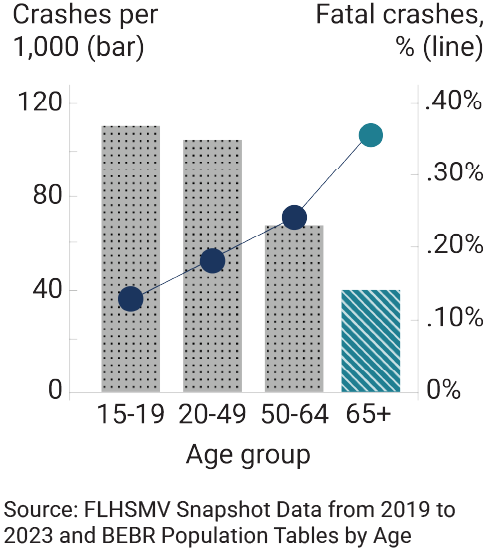
Older drivers are safe drivers compared to other age groups. However, they are more likely to be severely injured or killed in traffic crashes due to natural age-related vulnerabilities, which is supported by crash data. In Florida, drivers 65 years and older are involved in fewer crashes overall but face a higher fatality rate – nearly twice as many as drivers aged 20-49.
Understanding how aging impacts driving skills is key for all of us to remain safe drivers as we age. This webpage summarizes some of these natural age-related changes. You can learn more about these and other medical conditions that can your affect safe driving skills in Chapter 1 of Florida's Guide to Safe Mobility for Life.
Vision
Vision is the primary sense used in driving. According to the Federal Highway Administration, 90% of the information needed to stay safe on the road comes from our vision. Visual decline is the most critical loss for drivers of all ages. When driving, aging eyes need:
- More light to help distinguish features
- To be closer to properly read road signs and markings
- More time to recover from the glare of bright headlights at night or the sun
In Florida, all licensed drivers must have at least 20/70 vision in either eye or with both eyes together. Drivers 80 years of age or older who are renewing their driver license, must successfully pass a vision test administered at any driver license service center or provide a completed FLHSMV Mature Driver Vision Test Form completed by a physician licensed to practice in Florida or a licensed physician at a federally established veteran's hospital.
To learn more about driver license requirements, visit the FLHSMV's Driver License Renewal Requirements/Options for Older Drivers website.
Cognition
Cognition includes your thinking and how well you use your sensory perception, attention, learning, memory, thought, visual processing, reading and problem solving. Driving is a very complex activity that requires using many of these skills at the same time, whether driving a short or long distance.
When driving, you must remember how to operate your vehicle, understand what traffic signs and signals mean, know where you are going and how to get there safely. You must be able to do all these things in addition to processing any other information you encounter while behind the wheel.
When driving, some cognition issues may result in:
- Problems maintaining control of your car for long distances
- Trouble recognizing changes in traffic conditions, traffic hazards, or emergencies
- Safely responding to other users sharing the road including pedestrians and bicyclists
Normal aging brings mild, stable changes to our cognition. For more information on memory issues such as Alzheimer's disease or related dementias and how they can affect safe driving visit the Dementia and Transportation webpage.
Physical Ability
As we age, we usually lose muscle mass and bone strength, which increases our chances of injury or death in a crash. Decreased flexibility may cause rigidity or a limited range of motion in your neck, torso, arms, legs or joints. Simple range of motion exercises, stretches can help slow down the loss of flexibility and improve strength to benefit safe driving skills.
Medications
Older adults take longer to break down and eliminate any kind of medication, both prescriptions and over-the-counter drugs. According to AAA Safety Foundation, 90% of older drivers take prescription medications, and two-thirds of those taking any medication take multiple medications. When you are on multiple medications, the drugs may have adverse effects when combined and cause unaffected side effects that may affect your safe driving skills. Talk to your doctor or pharmacist about any medications you take to learn how they may affect your ability to drive safely.