
Safe Mobility for Life implements a proactive, research-based, data-driven approach to develop resources designed to support Florida's older adults in maintaining their safe mobility and independence, even beyond the driver’s seat. We use data to drive our decisions, prioritize our attention and resources, and monitor if we are making progress to reduce the number of fatalities and serious injuries involving Floridians age 65 and older.
On an annual basis, Safe Mobility for Life obtains official close-out data on crashes, population, and licensing from state sources to develop meaningful trends. This data is used to establish priority counties that also support our decisions as we implement the Safe Mobility for Life Strategic Action Plan.
Priority Counties
To provide consistency when monitoring trends from year to year, Safe Mobility for Life established a methodology to identify priority counties for urban and rural counties. Our methodology helps capture where crashes involving older adults, 65 years and older, may be over-represented relative to the county's 65+ population. Every year, we apply this methodology to the close-out data and use a 5-year average of the rate of crashes involving individuals aged 65+ compared to the population of 65+ in both urban and rural counties.
Access the latest Priority Counties Data here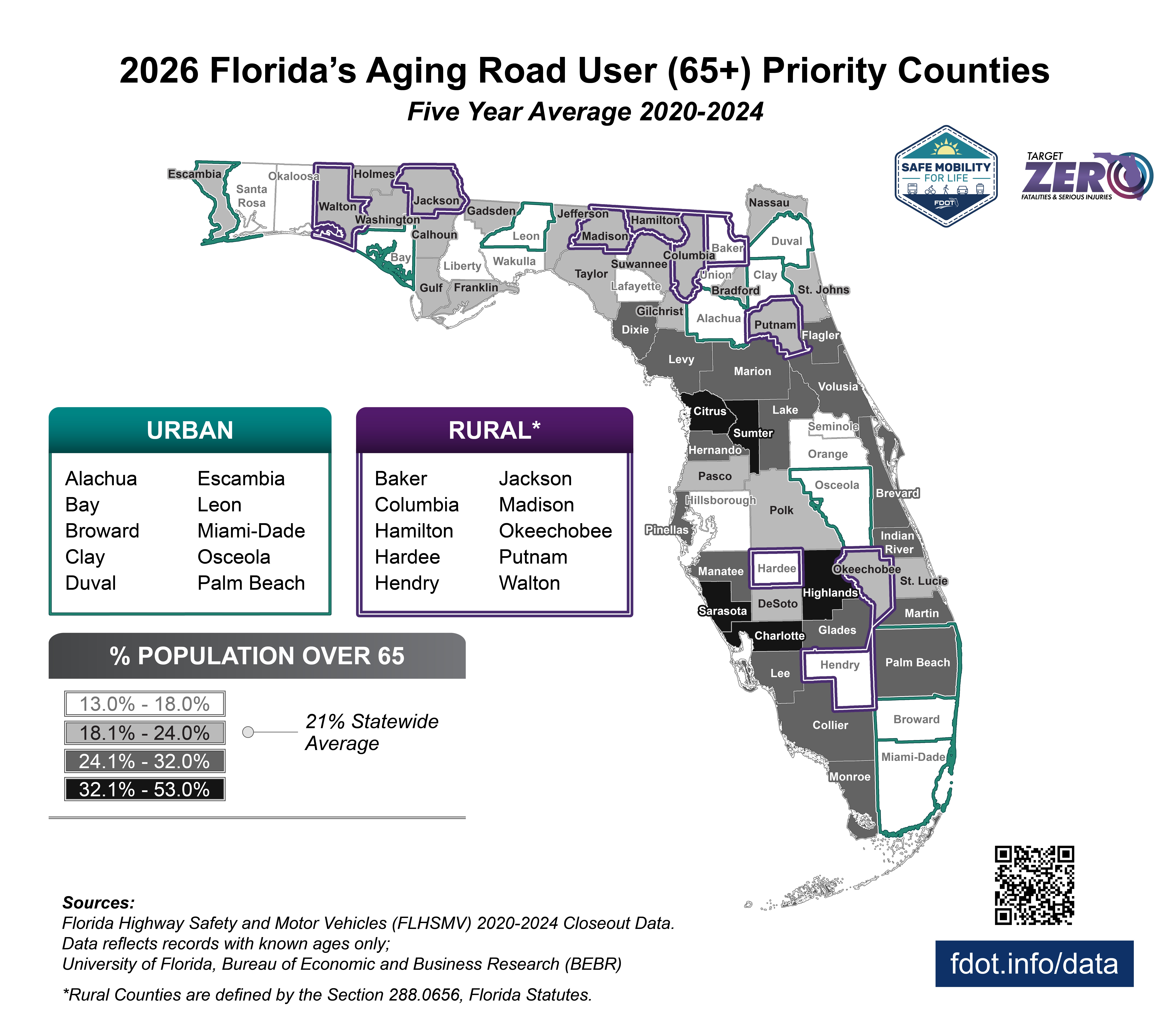
Data Sources
The following data sources are used to establish, analyze, and report on Safe Mobility for Life's annual data trends for aging Floridians:
- FLHSMV Crash Report data snapshot. This data is gathered from the Florida Department of Highway Safety and Motor Vehicles (FLHSMV) and is extracted and stored by the FDOT State Safety Office. The data extract occurs each year before the end of the year and includes the previous year's data.
- Signal Four Analytics (S4). This is an integrated platform for online GIS-based crash analysis, with support for data download for users. The primary data source for crash data is the FLHSMV and the source for citation data is the Florida Court Clerks Comptrollers.
- BEBR Population Estimates. The University of Florida's Bureau of Economic and Business Research (BEBR) is the official source for Florida's population statistics. The population projections, broken down by age, sex, and Florida counties, are used to develop various age-related statistics.
- FLHSMV Driver Licensed data. Like the population data, driver licensing data is broken down by age, sex, and county and is used to develop age-related statistics on the number of licensed drivers in the State.
For additional crash data and analysis resources FDOT's Safety Engineering webpage.
Frequently Asked Questions
For more detailed information, there are several resources available for exploration:
- eTraffic – Safe Mobility for Life tab
- Signal Four Analytics
- FDOT Safety Office’s Safety Engineering
Sources: FLHSMV Closeout Data (data reflects records with known ages only), BEBR Population Estimates, FLHSMV Licensed Driver Data.
No Warranties: This site and its content is made available by the Florida Department of Transportation on an "as is", "as available" basis without warranties of any kind, express or implied.
Disclaimer of Liability: The user of this application and data assumes all responsibility and risk for the use of both. Under no circumstances, including negligence, shall the Florida Department of Transportation, or its employees be liable for any DIRECT, INDIRECT, INCIDENTAL, SPECIAL, EXEMPLARY or CONSEQUENTIAL DAMAGES, or LOST PROFITS that result from the use, misuse or inability to use the application and data. Nor shall the Florida Department of Transportation, or its employees be liable for any damages resulting from or related to reliance; mistakes, omissions, interruptions, deletion of files, computer viruses, errors, defects, or any failure of performance, communications failure, theft, destruction or unauthorized access to the application and data.